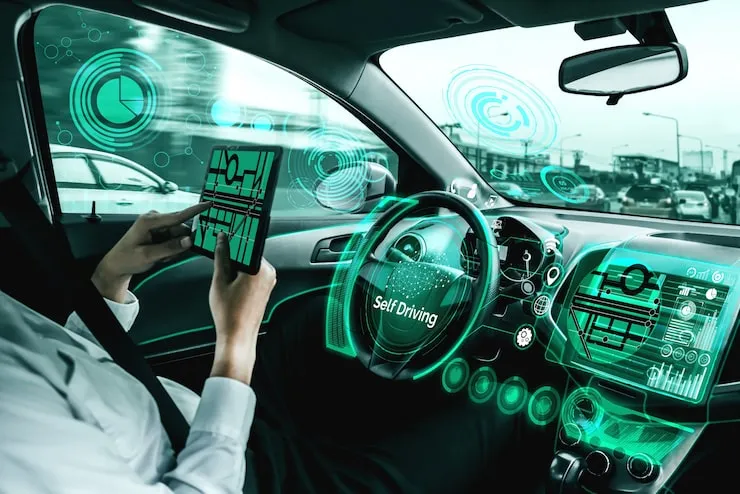
Envision a car that can see the street, make choices, and drive all by itself. It sounds like science fiction, but it’s getting to be science reality. These vehicles, regularly called independent vehicles, are being tried on streets right presently. This direct will clarify the enchantment behind the machine, breaking down how self-driving cars work in a straightforward, inviting way.
Your Direct to How Self-Driven Cars Work
At their center, self-driving cars are like super-smart robots on wheels. They do not get tired or occupied. Instep, they utilize a combination of high-tech eyes, ears, and a capable brain to get it the world and explore securely. The mystery isn't magic—it's a orchestra of sensors, maps, and computers working together.
The "Eyes and Ears": Sensors That See Everything
A human driver employments eyes and ears. A self-driving car employments a suite of vehicle sensors and discernment systems.
- Cameras: These are like the car’s eyes. They see path lines, studied activity signs and signals, and spot deterrents like people on foot and other cars.
- Radar (Radio Location and Extending): Think of radar as the car’s sense of touch. It employments radio waves to distinguish how distant absent objects are and how quick they are moving. It works incredible in rain, mist, or darkness.
- Lidar (Light Location and Extending): This is one of the coolest devices. A lidar sensor turns on the roof, shooting out millions of little laser bars each moment. It makes a super-detailed 3D outline of the car’s environment, measuring the correct shape and remove of everything around it. It’s like the car having a 360-degree see at all times.
By combining what its cameras, radar, and lidar see, the car builds a total, real-time picture of its environment. This handle is called sensor fusion.
The "Brain": The Computer That Makes Decisions
All the information from the sensors streams to the car’s fundamental computer, frequently called the independent vehicle computer framework or basically, the brain.
This isn't an conventional computer. It’s unimaginably effective. Its to begin with work is localization and mapping. This implies it answers the address: "Where am I?" The car compares its sensor information with unimaginably exact high-definition maps put away in its memory to know its correct position, down to the inch.
Next, it moves to way arranging and decision-making. Presently it answers: "What ought to I do following?" Utilizing complex calculations, the computer plans a secure way. It chooses when to speed up, moderate down, alter paths, or halt. It takes after all activity laws and security conventions automatically.
How Self-Driving Cars Explore Complex Roads
This is where it gets truly amazing. Let’s walk through a normal situation to see the step-by-step prepare of independent driving.
- Perception: The car’s sensors identify a ruddy light ahead, a cyclist in the bicycle path, and a car abating down in front.
- Prediction: The computer doesn’t fair see these objects; it predicts what they might do. It expects the cyclist might remain in their path and that the car in front will halt at the light.
- Planning: The car calculates a smooth arrange: "Start tender braking presently to halt comfortably behind the lead car at the ruddy light, whereas keeping up a secure buffer from the cyclist."
- Control: The computer sends moment commands to the vehicle control systems—the directing, brakes, and accelerator—to execute that arrange smoothly.
This all happens in milliseconds, over and over again!
The Part of Counterfeit Insights and Machine Learning
You might ponder, how does the car get so savvy? The reply is Fake Insights (AI) and Machine Learning (ML).
Engineers don’t program for each single conceivable circumstance on the road—that would be incomprehensible. Instep, they utilize ML to "educate" the car. They bolster the car’s AI millions of hours of driving information. The AI considers this information and learns designs, fair like a human understudy learns from encounter. It learns what a halt sign looks like from distinctive points, how people on foot regularly move, and the best way to combine into activity. This profound learning in car tech is what permits the car to handle unused, startling circumstances safely.
Safety To begin with: Repetition and Disappointment Protection
Safety is the most vital portion. What if a sensor falls flat? Self-driving cars are built with repetition. This implies there are reinforcement frameworks. If one camera gets grimy, others can offer assistance. If the fundamental computer has a issue, a reinforcement computer can take over. Numerous frameworks are continuously checking each other to guarantee secure navigation.
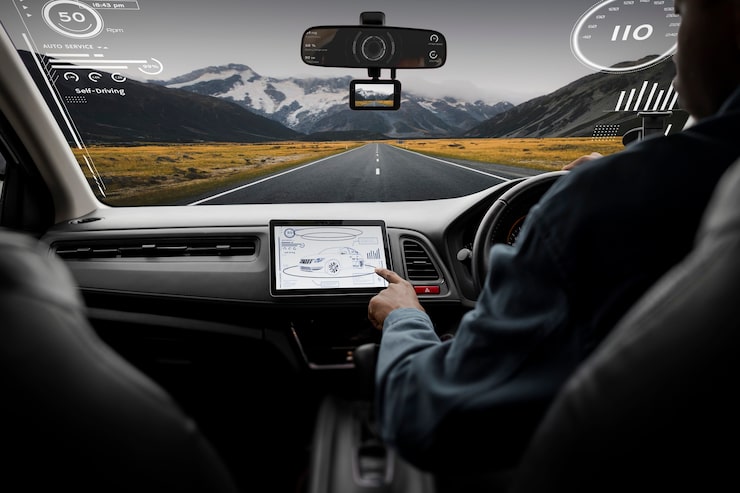
The Distinctive Levels of Self-Driving Technology
Not all self-driving tech is the same. The Society of Car Engineers (SAE) characterizes levels of vehicle computerization from 0 to 5.
- Level 1 (Driver Help): The car can offer assistance with either directing OR speeding up (like versatile voyage control). The human does everything else.
- Level 2 (Fractional Computerization): The car can control both controlling AND increasing speed at the same time (like on a few thruways). The driver must still pay full attention.
- Level 3 (Conditional Mechanization): The car can handle all driving in certain conditions, like a activity stick. The driver must be prepared to take over when asked.
- Level 4 (Tall Robotization): The car can drive totally by itself in a particular range (like a city or a interstate). No driver consideration is required in that "geo-fenced" area.
- Level 5 (Full Computerization): The car can drive anyplace, in any condition, that a human might. There might not indeed be a directing wheel!
Most cars on the street nowadays with "self-driving" highlights are at Level 2. Companies are thoroughly testing Levels 4 and 5.
Challenges and the Street Ahead
The way to completely driverless cars isn't without bumps. Engineers are still working on challenges like:
- Handling serious climate (overwhelming snow can square sensors).
- Navigating complex development zones.
- Understanding the unobtrusive communication between human drivers (like a wave to go ahead at a halt sign).
But advance is fast. Each mile of testing makes a difference the AI learn and improve.
Expert Bits of knowledge on the Future of Transportation
This innovation is reshaping our world. As mechanical autonomy master Dr. Kate Sweetheart notes, "The advancement of independent vehicles isn't fair approximately supplanting a driver; it's almost reconsidering our whole relationship with transportation, urban versatility, and city design."
The objective is a future with less mishaps caused by human blunder, less activity clog, and unused flexibility for individuals who can't drive. It’s approximately building a maintainable and effective transportation network.
Read More:- VFACTS New Vehicle Sales
Frequently Inquired Questions (FAQs)
Q: Are self-driving cars safe?
A: The objective of independent vehicle security is to be more secure than human drivers, who cause most mishaps nowadays due to diversion or mistake. Whereas not culminate however, they are outlined with numerous, repetitive security frameworks and never get tired or see at their phone.
Q: Can they drive in rain or snow?
A: This is a key challenge. Overwhelming rain, haze, or snow can meddled with camera and lidar sensors. Engineers are creating modern sensor advances and more brilliant program to offer assistance cars handle unfavorable climate conditions better.
Q: Who is capable if a self-driving car crashes?
A: This is a complex legitimate address still being worked out. It depends on the level of robotization and the particular circumstance. It may include the vehicle producer, the computer program engineer, or the human "security driver" if one is present.
Q: When will we all have self-driving cars?
A: Completely independent cars (Level 5) that can go anyplace are likely still a long time absent. In any case, we are as of now seeing more progressed driver-assistance frameworks (Level 2/3) in modern cars, and a few cities are beginning to see restricted robotaxi administrations (Level 4).
Q: How do they get it activity cops or hand signals?
A: This is where progressed AI and machine learning come in. The cars are prepared on thousands of pictures and recordings of activity officers and hand signals so they can recognize and react to them, fair like they do for a standard activity light.
The travel of how self-driving cars work is a intriguing story of human inventiveness. By understanding the mix of sensors, keen computer program, and security frameworks, we can superior appreciate this mind blowing innovation that’s controlling us toward an energizing unused future on the street.